
Start with the outfit you keep reaching for
If you repeatedly leave a hoodie unzipped over a favourite T-shirt, the front opening is doing useful work. If you want to put on one substantial top and leave the house, a pullover may suit that habit better. If a jacket has a large collar or hood, a crewneck can create a simpler neckline beneath it.
This is a more practical distinction than treating all sweatshirts as interchangeable. The same black colour can produce three different arrangements of fabric around the chest, waist and neck. Your next piece should solve a gap in those arrangements, rather than add another similar thumbnail to a saved list.
A hoodie can sit beneath a workwear-style jacket or alongside more structured clothes, as well as within a relaxed casual outfit. [1] Proportion and setting change the effect: the same hooded top can become an open layer, a statement shape or part of a coordinated set. [2]
Compare the same outfit in all three shapes
Keep the trousers, shoes and T-shirt the same while changing the sweatshirt. With an open zip-up, the T-shirt remains part of the composition. With a pullover, its print may disappear and only a small edge remain. With a crewneck, the neckline becomes simpler and the jacket can contribute more of the detail. This comparison makes the difference visible without relying on a brand name.
Fit, neckline and the type of opening are separate choices in a sweatshirt, and they influence the garments you can combine with it. [3] An oversized crewneck can be more visually substantial than a neatly cut hoodie. A zip does not automatically mean slim, and a pullover does not automatically mean baggy. Separate the category from the cut when browsing.
Imagine two actual days: one with the outer layer on for most of the journey, another spent indoors with the sweatshirt visible. If the same piece works in both versions, it offers a useful everyday role. If a graphic only makes sense with the jacket removed, decide whether that reflects your routine. The table gives starting points for the comparison.
| What you want to show | Shape to try first | Main tradeoff |
|---|---|---|
| A favourite T-shirt | An open zip-up | The closed version needs to work as well. |
| The sweatshirt itself | A pullover | Its hood and volume may crowd an outer layer. |
| A collared jacket | A plain crewneck | The outfit depends more on the jacket and lower half. |
The zip-up: useful when the T-shirt matters
An open zip-up makes two vertical edges around the T-shirt. That can give a broad or graphic top a clearer frame. Start with a neutral zip-up and a shirt whose print you want to show. Keep the zip-up's own decoration modest if the shirt already has a large image.
The tradeoff appears when you close it. A zip-up that looks balanced open may sit differently at the waist once fastened, particularly if the body and hem are wide. Judge both versions. You may prefer a shirt that sits just inside the hoodie hem, or a small visible strip underneath; a long uneven layer can look accidental.
A zip-up over a fitted inner layer creates a different outline from a large pullover over loose bottoms. [2] For an everyday streetwear version, try your own straight trousers and plain sneakers. Compare the combination with the hoodie open and closed.
Body length and hem shape change the result
A sweatshirt's hem can sit close to the waist, fall loosely over it or gather the fabric into a rounded shape. Two tops with similar body measurements can therefore finish quite differently. When the hem draws inward, the garment may sit higher while you move; when it hangs straight, more of its full length may remain visible. Look at worn photos as well as a flat product image.
For an open zip-up, compare the T-shirt edge against both sides of the opening. A shirt that hangs much lower can become the dominant horizontal line. That might suit a layered look, but it can also undermine the shorter jacket silhouette you wanted. Try an inner shirt nearer the zip-up's length before changing the outer piece.
For a pullover or crewneck, compare where the hem finishes against the trouser waistband and pockets. If it covers every detail of the trousers, the upper half will carry more of the outfit. A shorter finish reveals more of the lower half. Choose the balance with your usual trousers on, then use garment measurements to find that cut instead of assuming that sizing up will produce it.
The pullover: let one shape carry the upper half
A pullover gives you an uninterrupted front. That makes it a natural choice when a chest graphic or distinctive colour is the part you want people to notice. A roomy pullover with equally wide trousers creates a relaxed silhouette; a straighter lower half puts more emphasis on the volume of the top.
The neckline and hood are already adding fabric near your face. If you intend to wear a jacket, compare how those shapes sit together. A tall hood under a short collar may need arranging, while two hoods can look bulky. You do not have to eliminate that volume, but it should be part of the look you want.
Choose between a statement pullover and a quiet one by thinking about your outerwear. A bold graphic is useful when the hoodie will be visible on its own. If it mostly lives underneath a closed jacket, a simpler colour may be easier to rotate with the rest of your clothes.
Plain colour or graphic: give each a useful role
A plain sweatshirt makes it easier to rotate patterned trousers, colourful sneakers and different jackets. A graphic sweatshirt contributes an obvious point of interest to an otherwise simple outfit. Neither is inherently the better buy. Look at the clothes that need a partner: a wardrobe full of statement tops may benefit from a quiet layer, whereas plain jeans and shoes can give a graphic plenty of space.
Consider where the graphic sits. A large back design is most visible when the sweatshirt is worn on its own. A small chest detail can remain visible beneath an open jacket. If you routinely wear a backpack, its straps and body may cover parts of a design you particularly like. Picture those overlaps before choosing a print from a cropped catalogue photo.
For colour, build a pair of combinations rather than trying to cover every occasion. A navy crewneck might join blue jeans on one day and beige trousers on another; a grey hoodie might sit below a dark jacket or above black shorts. You can then decide whether a more unusual colour adds a distinct combination or simply repeats the job of something you own.
The crewneck: make room for the jacket
A crewneck removes the hood and front zip from the equation. It is a useful starting point for a collared jacket, overshirt or coat because there is less fabric competing around the neck. A small T-shirt edge can add contrast; too many stacked collars can make the same area look crowded.
For a restrained outfit, pair a navy or grey crewneck with straight trousers and a short jacket. For a casual one, use jeans and a cap. The difference comes from the supporting pieces, not a rule that crewnecks are formal. If you want a large back graphic, a pullover may serve that purpose better; if you want the jacket to be the focus, a plain crewneck can stay in the background.
Here are three examples to compare by opening, hood and neckline. Check the full listing for the current item and selected option.
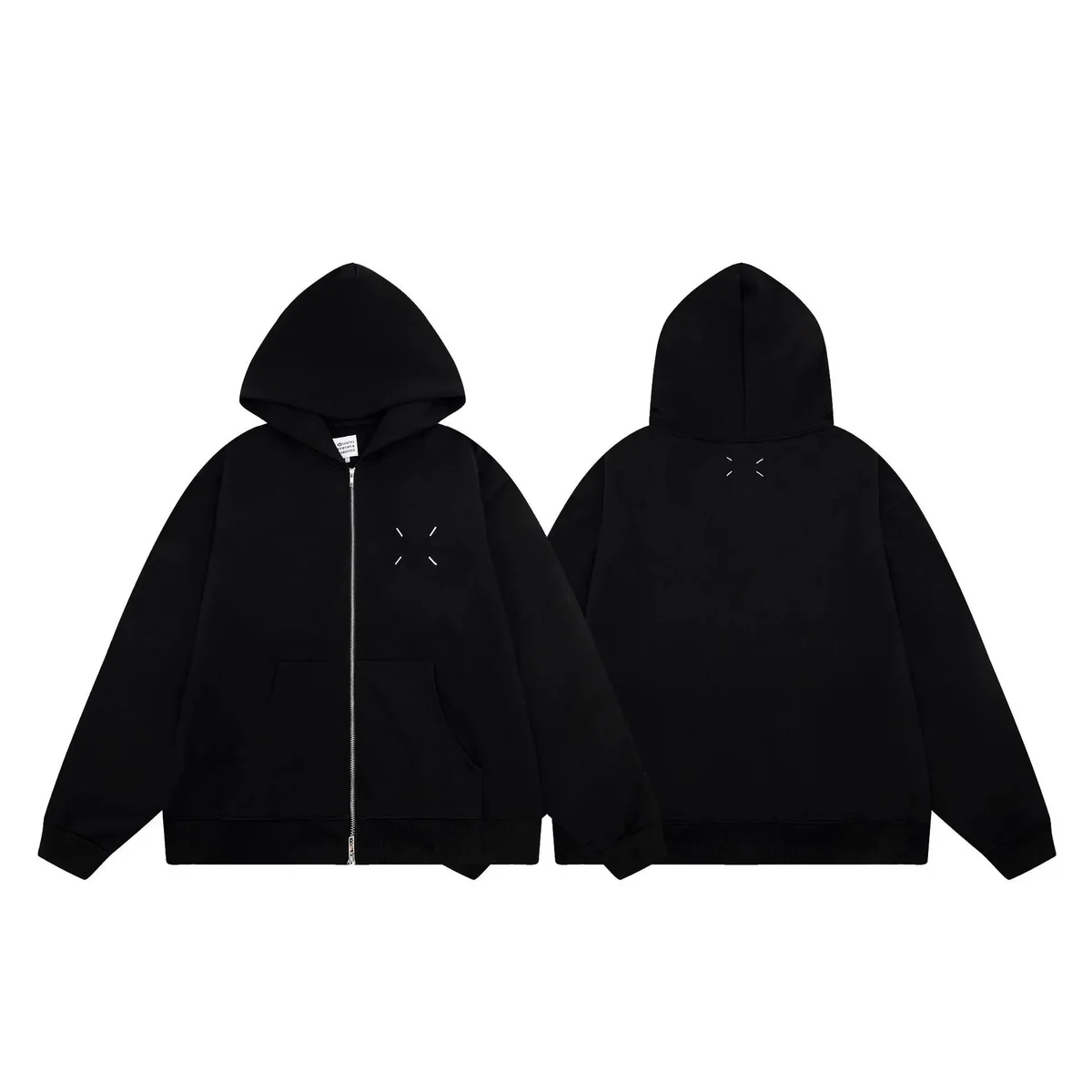
An open front can frame a contrasting T-shirt.
View current listing ↗
A large back graphic adds a statement when the hoodie is worn without an outer layer.
View current listing ↗
A simple neckline leaves a collared outer layer more space.
View current listing ↗Match the choice to your ordinary week
For a day split between travelling and sitting indoors, an open-front layer is a starting point if you like changing the arrangement of your outfit. You can show the tee when the zip-up is open and compare a simpler closed front later. The practical limit is the cut: an opening does not solve a body that is too tight over the shirt or sleeves that bunch under your jacket.
For an easy weekend outfit, try a pullover with straight jeans and a restrained sneaker. If you want a wider, more relaxed shape, change the trousers rather than merely increasing the hoodie size. Excess sleeve length and a long body are different from the broad, intentionally roomy outline you may be aiming for.
For a setting where you want a cleaner appearance, start with a plain crewneck, unmarked trousers and a collared outer layer. That combination can feel more restrained, but it does not override a workplace or venue's dress expectations. The useful purchase is the one that supports the days you have, without requiring you to invent a new routine to wear it.
Buy for a missing role, then confirm the cut
If you own several pullovers but struggle to show a graphic tee underneath them, an open-front piece adds a different role. If your jacket collar fights with every hoodie you own, try a crewneck before buying a fourth hooded top. A useful addition changes the combinations available to you.
Once the role is clear, compare the garment measurements with a top that already fits. A familiar letter size does not tell you the body length, sleeve length or hem width. The size guide covers that check. For the outer layer itself, continue with autumn and winter layering, where the jacket is the starting point.
Explore hoodies.
Open the current category to compare designs and available options.
Browse this category in the directoryHoodies Browse hoodies ↗References3 sources
- MR PORTER — Ayrton Reeves — The Ultimate Guide To Wearing A Hoodie
Published editorial on the hoodie in casual and more structured outfits.
Accessed - Nike — Aemilia Madden — How to style a hoodie
Styling article using proportion, layers and different settings to build hoodie outfits.
Accessed - Nike — How to Style Your Go-To Hoodie or Sweatshirt for Any Occasion
Published styling article distinguishing sweatshirt cuts, necklines and openings, with casual and more restrained outfit examples.
Accessed